
I've already told you in this blog post that Archie is epileptic. What does that actually look like? What forms does it take? What do you need to keep in mind when giving medication? What else should I watch out for? How can you help yourself cope?
Here I want to give you a little insight into everything I've learned about this illness and how we make the "management," the day-to-day routine and life with Archie's diagnosis a little easier. This is a purely personal account and is not a substitute for veterinary advice.
If you have any questions, please consult your trusted vet.
Epilepsy – what does this diagnosis mean?
This diagnosis means that the nerve cells are more easily excitable, which can lead to seizures. Unfortunately the illness is NOT curable, but with good medical management a dog can still lead a fulfilling life and even reach old age.
What is the origin of the illness?
The illness is divided into primary and secondary epilepsy.
Primary epilepsy is also called idiopathic epilepsy. Here, no specific cause can be identified. It is therefore assumed to be genetic in origin. The diagnosis is made through a process of elimination involving many tests. The first seizures can appear as early as the first year of life.
Commonly affected breeds include:
- Labrador and Golden Retriever
- Australian Shepherd
- Border Collie
- Boxer
- Magyar Vizsla
- Poodle
- Dachshund
- Beagle
- Pug
Secondary, or symptomatic epilepsy, can be triggered by various illnesses. Tumours, metabolic disorders or poisoning can all be causes of seizures.
Epilepsy unfortunately has many faces, and hardly any two cases are alike. That's why an appropriate therapy should always be discussed individually with your vet.
What types of seizures are there?
Seizures can present in different ways. Focal seizures can manifest, for example, as mild twitching of the face or limbs. A so-called generalised seizure (formerly known as grand mal) causes the muscles to stiffen and brings the dog to the ground. Paddling movements of the limbs, excessive drooling, and loss of bladder or bowel control can all be normal accompanying symptoms.
These generalised seizures last for a few minutes. If a seizure lasts longer than 5 minutes, it is referred to as status epilepticus. Seeking veterinary attention immediately is strongly recommended in this case, as the prolonged duration puts the body at risk of overheating and can also cause brain damage.
When more than 2 seizures occur within 24 hours, this is called a cluster or series. If multiple generalised seizures happen in a short space of time, it is highly advisable to consult a vet or animal clinic quickly.
What should you do when a seizure occurs?
Stay calm! Even if that is definitely easier said than done, it doesn't help your dog if you completely lose your composure. And even though a seizure is awful to watch and we suffer terribly seeing it, in the vast majority of cases a dog is unconscious during a generalised seizure. That means they are not aware of what is happening.
You should also, as best you can, secure the dog to protect him from injury. This includes things like: moving coffee tables with sharp corners out of reach or blocking off staircases. Since the patient not only paddles with his limbs but also has no control over his jaw, you should keep your hands away from his head.
Since seizures often start during sleep, you need to be careful that your dog doesn't fall off the sofa or out of bed, that is, if he's allowed to nap there ;)
For an epileptic dog it's also very helpful to switch off the lights and the TV or other sources of noise.
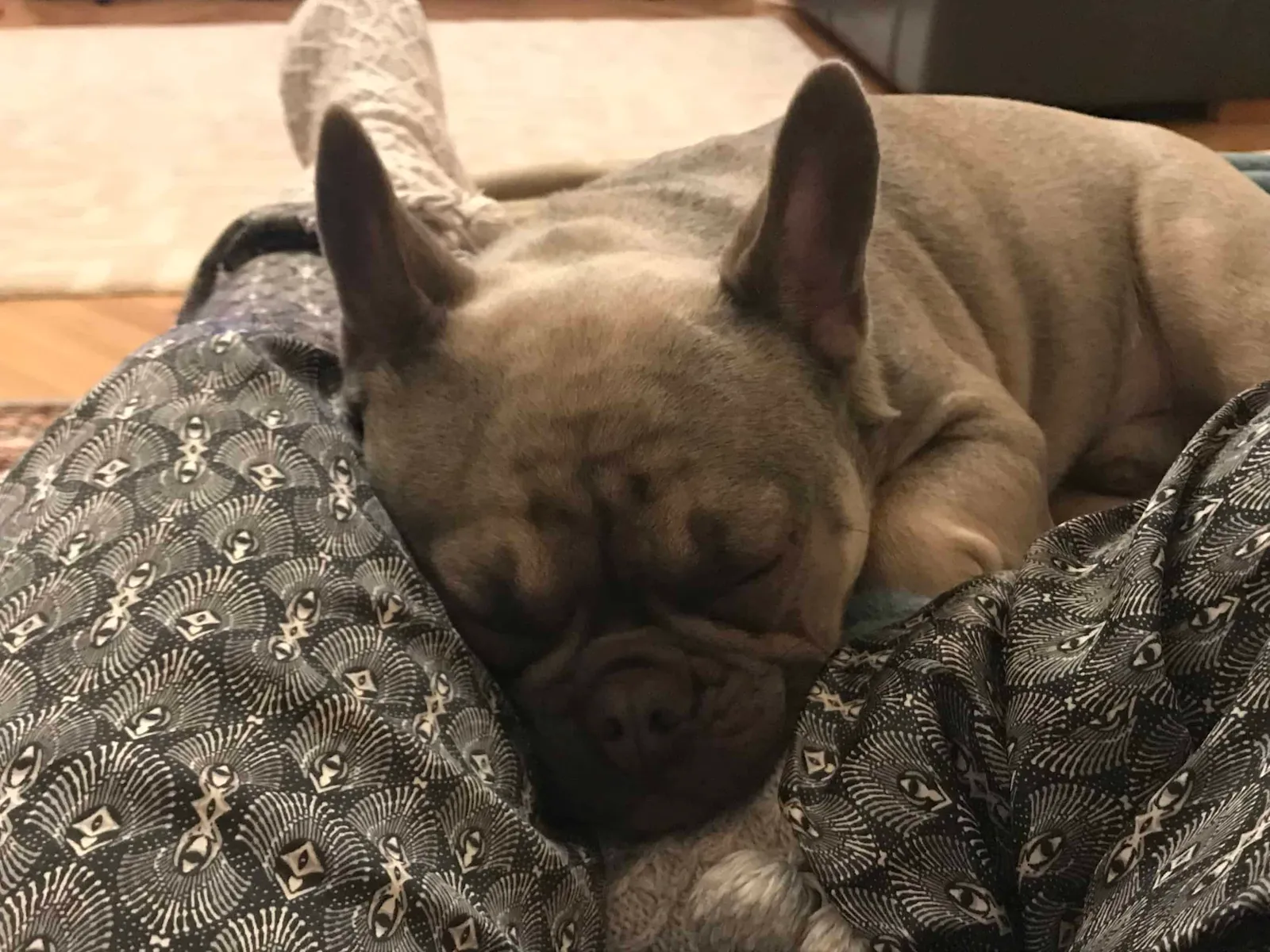
We also got puppy training pads that we slide under Archie when he's having a seizure. Since he usually urinates, we avoid a flood on the floor, carpet, bed, and so on.
If you have an emergency medication at home, make sure it's close at hand.
It is also recommended to document the seizure. That does require some real nerves of steel, though. But vets can learn a great deal from videos, and it can help support further treatment.
You can expect a range of reactions once your dog comes out of a seizure. Anything from restlessness, compulsive wandering, temporary blindness or aggressive behaviour (because the epileptic temporarily doesn't recognise their owner) right through to a deep, heavy sleep is possible. If the seizure doesn't end, you should get quickly to a vet or animal clinic.
What do you need to keep in mind when giving medication?
We have diazepam at home as an emergency medication. These tubes can be given rectally during a seizure to help calm the nerve cells again.
Once seizures reach a certain frequency, medication therapy is usually started. We wanted to wait and see with Archie too, but after he had a status epilepticus followed by a cluster series, we had no other choice.
We give him phenobarbital twice a day. It is recommended to give this on an empty stomach to ensure the best possible absorption of the active ingredient. This means that in our case, Archibald gets nothing to eat for 2 hours before and after. Side effects such as excessive hunger (already a permanent state for Archie), increased thirst (and consequently more frequent urination), restlessness, or comatose sleeping, normally settle down after about 2–3 weeks.
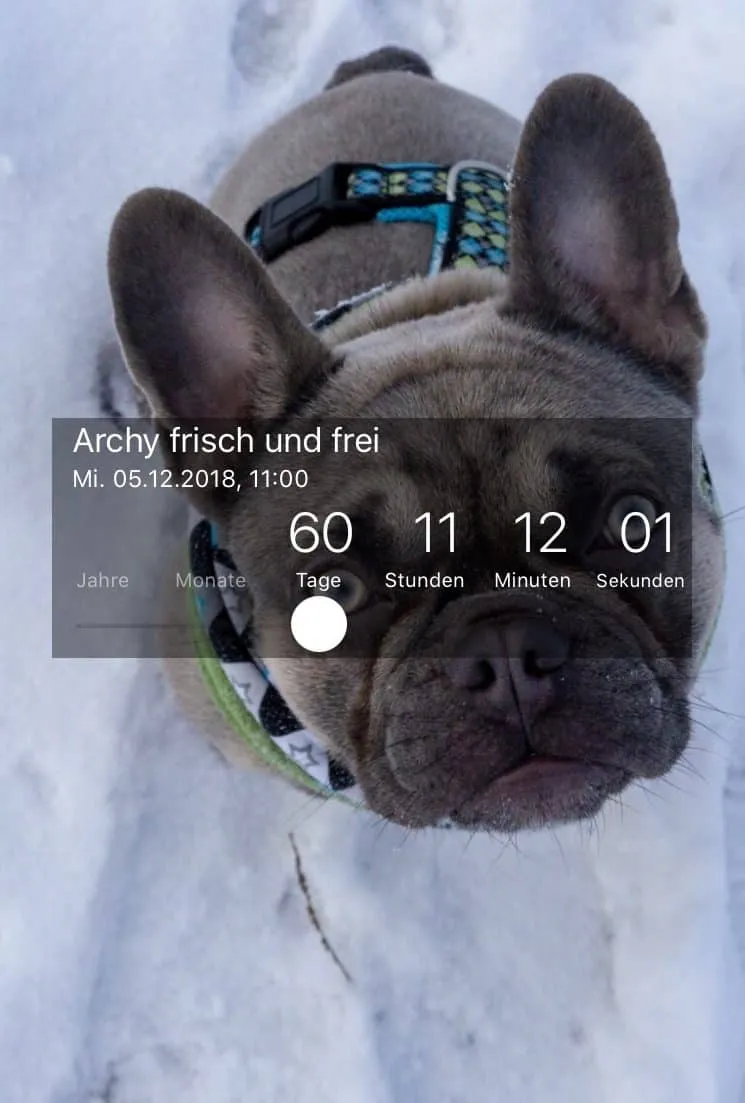
Since the last cluster series in February 2019 (in between, Archie was fortunately 60 days completely free from visits by the witch), he also receives a human medicine preparation three times a day, which is intended to prevent cluster seizures.
The most important thing with all tablet doses is to keep the intervals and times exact! This prevents fluctuations in the blood level.
How can you make epilepsy management easier?
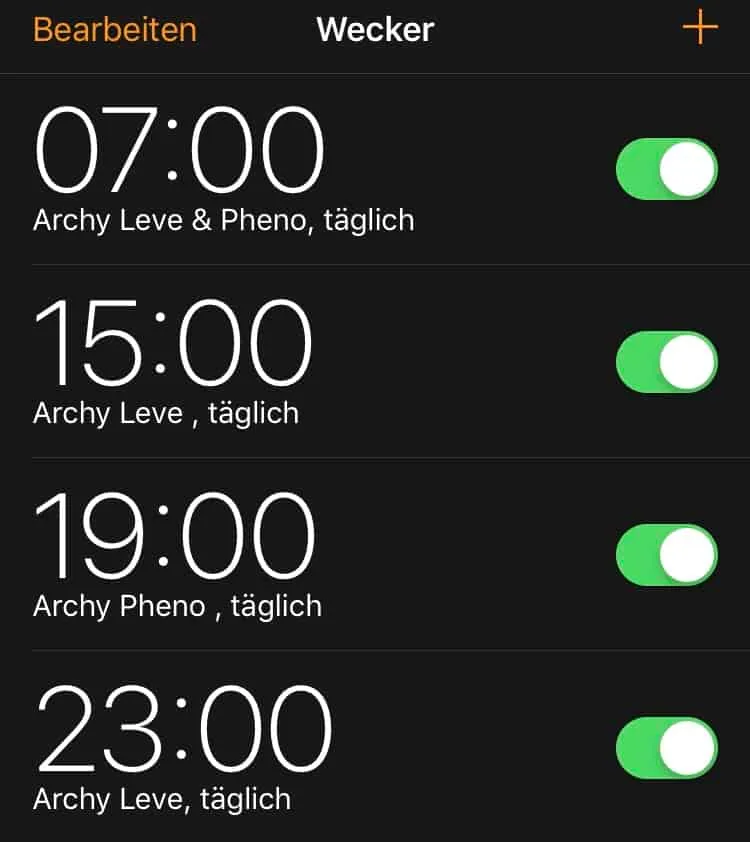
Archie gets his medication at 4 different times of day: 7/15/19/23.
As punctually as possible, down to the minute. That takes quite a bit of organisation.
So we started setting alarms for his medication times so we're always reminded in time.
We keep an "Archie epilepsy diary" where everything is recorded:
- Number, severity, duration and date of seizures
- Medication dosage and any changes
- Other illnesses or injuries and their treatment
I also installed a countdown app on my phone where I can see exactly how long Archie has been going strong and seizure-free:
We knew that Archie had epilepsy, but the extent of it, the status epilepticus and the cluster series, really knocked us off our feet, as they say... In the beginning our nerves were pretty frayed and I have to admit: we weren't sure whether we could keep going with all of it.
Support (Update: Autumn 2019)
What helped me/us enormously was reading up on the topic and doing research. There is an incredibly wonderful Facebook group where I found a huge number of helpful tips. Unfortunately, quite a few vets are also a little out of their depth with this diagnosis, or treat it according to a one-size-fits-all approach. Specialists in the field of neurology are few and far between in Austria. However, we have since found a great network of doctors who look after us and Archie with real expertise.
First and foremost Dr. Benjamin Andreas Berk, alias "our Dr. Benny", who is based in Mannheim and with whom we have regular telephone consultations. Systematically we went through the entire epilepsy management with him, and over the summer we also changed Archie's diet. That one measure alone was able to raise his phenobarbital level by 10 points, which is a very positive result.
So sleeping in is a thing of the past. ;) But the main thing is that Archie is simply ALWAYS happy, that he's part of the family and we get so much back from him. And besides, on Sundays you can still snuggle up and doze off again with your favourite person and your furry companions ♥